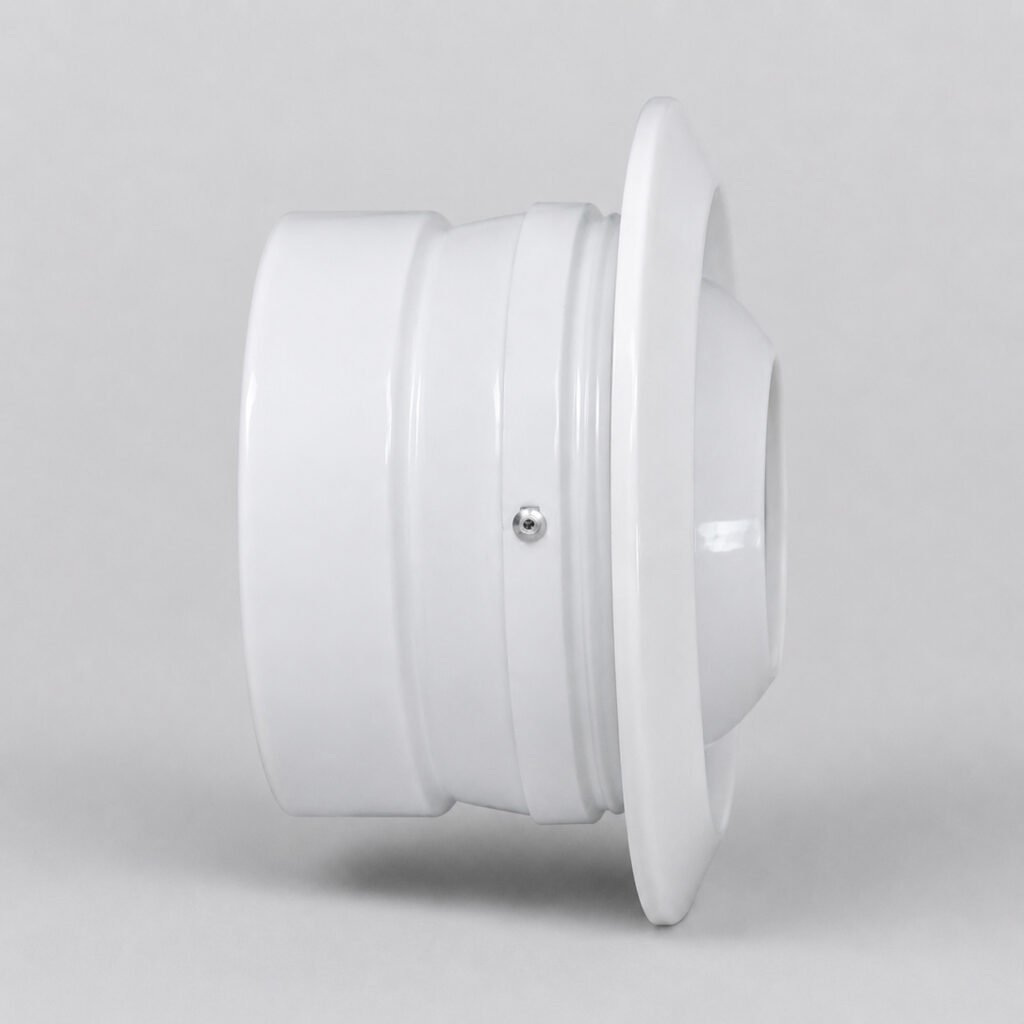
Jet nozzle diffuser installation should be planned from the approved product drawing and the HVAC layout together. Before ordering or closing the wall or ceiling, confirm the selected model, face and connection dimensions, opening, mounting support, duct route, nozzle aiming range, damper access, and commissioning responsibility. A nozzle that fits the opening may still be unsuitable if it cannot be aimed or serviced as the design requires.
This guide is for contractors and buyers coordinating a directional supply-air outlet in a large commercial space. JOYOAIRE’s aluminum jet nozzle range has a manually adjustable nozzle and an optional volume damper, subject to model and project confirmation. Installation details vary by model. Use the approved JOYOAIRE drawing and project specification for actual dimensions and fixing details.
Start with the exact jet nozzle model and drawing
“Jet nozzle” describes a product family, not a universal opening or connection. JOYOAIRE’s catalog shows a Jet Nozzle Diffuser and an Eyeball Jet Nozzle Diffuser as separate models with different drawings and dimension tables. If a schedule uses “ball jet,” “eyeball jet,” or “jet nozzle” loosely, resolve the model before the builder sets out the opening. The ball jet and jet nozzle terminology guide explains why the names alone do not establish equivalence.
Check the visible face, neck or spigot, overall depth, fixing points, adjustment clearance, and any accessory shown on the submitted drawing. Mark whether a stated dimension is a face size, connection size, or builder’s opening; these are not automatically the same. Confirm the drawing revision against the purchase order and site layout.
Coordinate the mounting surface and duct connection
JOYOAIRE jet nozzles may be reviewed for wall or ceiling project installation, but the fixing arrangement and any direct-duct connection must be confirmed for the chosen model. Establish whether the outlet meets a duct face, wall, bulkhead, or ceiling assembly. The mechanical and architectural teams should agree on the opening, finished-face position, fixing substrate, and permitted access before fabrication.
Do not rely on the diffuser face to carry adjacent ductwork. Confirm the support design, duct alignment, connection seal, and access under the project drawings and local requirements. As a general installation reference for a different manufacturer’s jet nozzle, the TROX TJN installation manual calls for fixing to load-bearing elements, separate support for connecting ducts, and cleaning access. Its hardware and dimensions must not be applied to JOYOAIRE products without the JOYOAIRE model drawing.
Allow for aiming and damper access
The nozzle’s purpose is directional supply air, so the team must check where it can actually point after installation. Record the design aim on the reflected ceiling plan or elevation. Check for beams, signs, lights, sprinklers, doors, maintenance platforms, and occupied areas that could obstruct the air path or prevent adjustment. Confirm the available adjustment range for the selected model rather than assuming every jet nozzle rotates through the same angle.
If a volume damper is required, state whether it is included with the diffuser, supplied separately, or located upstream. Confirm how the balancing technician will reach it after finishes and adjacent services are installed. The damper choice should follow the HVAC balancing plan; an optional accessory does not establish a required setting or guarantee system performance.
What should the installation handoff include?
| Handoff item | Check before release | Responsible confirmation |
|---|---|---|
| Model and drawing | Model code, revision, face, connection, depth, fixing and finish | Buyer and supplier |
| Mounting location | Wall/ceiling/duct interface, opening, structure and service clearance | Mechanical and architectural trades |
| Duct and damper | Connection alignment, independent duct support, damper scope and access | Mechanical contractor |
| Air direction | Intended aim, nearby obstructions and adjustment/maintenance access | HVAC engineer and commissioning team |
| Performance review | Design airflow, available pressure, target throw, room geometry and sound criteria | Responsible HVAC engineer using verified selection data |
Confirm actual airflow, throw, pressure drop and sound suitability from the selected size, system conditions, installation height, room geometry, operating mode and verified technical data. None can be inferred from the product name, nozzle direction, or opening size. For application context, see when a jet nozzle diffuser is considered for large spaces.
What should a buyer send with the RFQ?
Send the diffuser schedule and current drawing, installation elevation or ceiling plan, mounting condition, face/opening/duct connection dimensions, quantity, finish, and destination. State whether a damper is required and who supplies it. Include the intended air direction and any access limitation. Where available, provide design airflow, available pressure, target throw, installation height, room dimensions, heating/cooling mode and sound criteria for engineering review.
Review the JOYOAIRE jet nozzle diffuser product range, then send the drawing and installation details to JOYOAIRE for a project quotation. JOYOAIRE is a China-based manufacturer of HVAC air diffusers, grilles and air distribution products. Available model dimensions, fixing details, finish and damper options are to be confirmed based on project specifications; performance approval remains with the responsible HVAC engineer.
Frequently asked questions
Can a jet nozzle diffuser be mounted on a wall or ceiling?
JOYOAIRE’s verified product information identifies wall or ceiling project installation. The exact fixing method, support, opening and connection must be checked against the selected model drawing and site condition.
Is the face diameter the same as the duct opening?
Do not assume so. The visible face, connection and builder’s opening may have different dimensions. Confirm each on the approved drawing before cutting the opening or ordering a duct transition.
Does every installation need a volume damper?
No universal damper requirement follows from the product name. JOYOAIRE lists an optional volume damper; the engineer should confirm the balancing approach, accessory scope and access for the selected installation.
Who sets the final nozzle direction?
The HVAC design should define the intended air path. The commissioning team should set and verify the installed direction against that design, while the engineer confirms airflow and occupied-zone suitability using project conditions and verified data.