
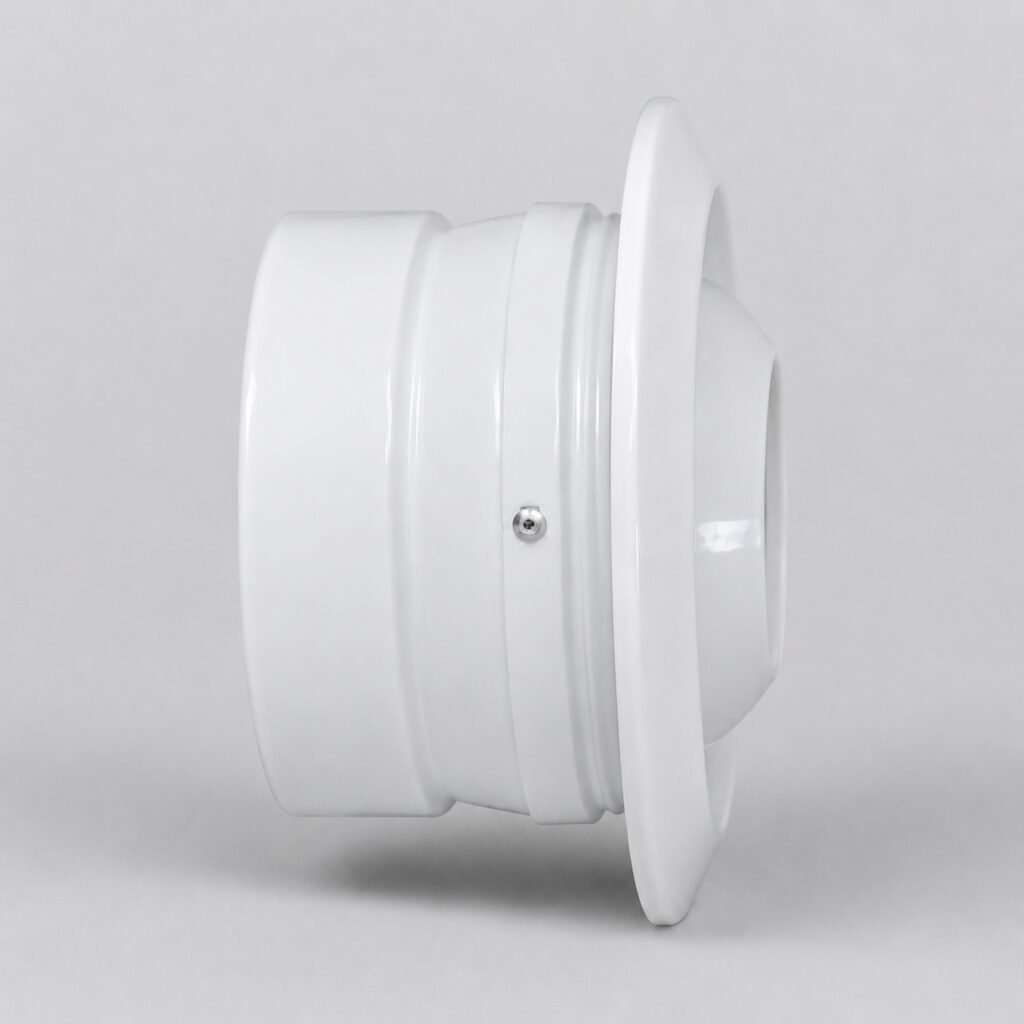
Jet nozzle vs drum louver diffuser selection starts with the required air path, mounting position, opening and connection dimensions, adjustment needs, architectural appearance, and verified size-specific performance data. Both are directional supply-air outlets for large spaces, but they should not be substituted on the strength of a product name or a promised throw distance. The responsible HVAC engineer must confirm airflow, available pressure, throw, sound, and occupied-zone conditions for the actual project.
This guide is for engineers, mechanical contractors, distributors, and project buyers comparing outlet types before a drawing is approved or an RFQ is issued. JOYOAIRE is a China-based manufacturer of HVAC air diffusers, grilles, and air distribution products. Its jet nozzle diffuser range and drum louver diffuser product page provide the starting points for model-specific review.
Why are these outlets compared?
Both families can be considered where supply air needs a directed path from a wall, high-level position, or other project-defined location. They may appear on the same shortlist for an atrium, hall, terminal, or similar open space. That shared use does not make their mounting details, discharge adjustment, or performance interchangeable. A product drawing and selection data are needed for each proposed model.
The names also describe different product forms. JOYOAIRE’s verified jet nozzle is an aluminum outlet with a manually adjustable nozzle; an optional volume damper can be reviewed for the selected configuration. The JOYOAIRE catalog identifies its FK015 drum-shaped jet diffuser in aluminum. Its exact dimensions, discharge adjustment, finish, mounting detail, and accessory scope must be confirmed from the approved drawing and quotation.
What should the project team compare?
| Decision point | Jet nozzle review | Drum louver review |
|---|---|---|
| Air path | Confirm the target direction and whether the manually adjustable nozzle can be set as required. | Confirm the required discharge direction and the selected model’s adjustment method and range. |
| Architectural interface | Check visible face, projection, opening, connection, and wall or ceiling detail against the jet nozzle drawing. | Check face, opening, connection, overall depth, and mounting support against the FK015 or other approved drawing. |
| Airside accessories | State whether an optional volume damper is required and confirm its available configuration. | List any damper, actuator, or other control requirement for availability review; do not assume it is standard. |
| Performance approval | Obtain size-specific airflow, pressure, throw, and sound data for the proposed mounting and air path. | Request the same size-specific evidence and review it against the same project criteria. |
| Order scope | Confirm size, finish, quantity, installation conditions, and packaging. | Confirm model, dimensions, finish, quantity, mounting, accessories, and packaging. |
The table is a comparison checklist, not a performance ranking. A larger face, different outlet form, or adjustable component does not establish which model will meet a particular throw or sound target. ASHRAE’s Room Air Distribution Equipment chapter provides broader engineering context for selecting air outlets; the final product choice still needs approved project data.
When is a jet nozzle the better candidate?
Review a jet nozzle when the design calls for a compact, manually aimed outlet and the proposed wall or ceiling location can accommodate its approved opening, connection, support, and adjustment clearance. JOYOAIRE’s jet nozzle range is considered for directional supply air in large spaces, including terminals, stadiums, and exhibition halls. The jet nozzle application guide explains the broader use case, while the installation planning guide covers duct, mounting, aiming, and access handoffs.
The engineer should test the proposed size and angle against design airflow, available pressure, target throw, installation height, room geometry, heating and cooling modes, return-air path, and sound criteria. If those inputs or verified selection data are missing, the jet nozzle’s suitability remains to be confirmed based on project specifications.
When is a drum louver the better candidate?
Review a drum louver when the approved design calls for its drum-form face or mounting arrangement and the proposed model’s drawing can meet the opening, connection, support, and discharge-direction requirements. JOYOAIRE’s catalog identifies FK015 as an aluminum drum-shaped jet diffuser. Its finish and any damper or control accessory require order-specific confirmation. For a model-specific buyer checklist, see the Drum Louver Diffuser selection guide before the drawing and RFQ are approved.
Do not assume that a drum louver will handle more airflow, throw farther, or produce less noise than a jet nozzle. Those outcomes depend on the selected size, airflow, available pressure, discharge angle, installation height, room geometry, temperature conditions, and sound limits. Compare approved, size-specific data for both candidates under the same design conditions.
What must be resolved before substitution or quotation?
An approved jet nozzle schedule should not be changed to a drum louver, or vice versa, by matching nominal face size alone. Ask the design and procurement teams to confirm:
- The required outlet location, target air path, and permitted aiming range.
- Face, opening, neck or connection, projection, and overall dimensions on each proposed drawing.
- The available duct route, structural support, installation sequence, and later access for adjustment or balancing.
- Design airflow, available pressure, target throw, sound criteria, installation height, room geometry, and operating modes.
- Required finish, quantity, damper or control scope, packaging, and delivery destination.
Where performance data or a connection detail is unavailable, mark it to be confirmed based on project specifications. The HVAC engineer should approve the air-distribution result; the supplier should confirm the quoted model, dimensions, construction, finish, and accessories against the approved documentation.
Frequently asked questions
Are jet nozzles and drum louvers interchangeable?
No automatic substitution is safe. Both can deliver directional supply air, but the approved drawings, connection and mounting details, adjustment method, and size-specific performance must be compared before a change is accepted.
Which outlet has a longer throw?
Neither outlet type has a universal advantage. Compare verified selection data for the proposed sizes at the project’s airflow, pressure, discharge angle, mounting height, room geometry, and temperature conditions. JOYOAIRE does not state a guaranteed throw value for either option here.
Can the same duct opening be used for both?
Do not assume so. Check face, opening, connection, and overall dimensions on both approved drawings, then coordinate any required duct, support, and architectural changes with the contractor.
What should a buyer send to compare quotations?
Send the diffuser schedule or drawing, required outlet location and air path, available connection dimensions, airflow and pressure inputs, target throw and sound criteria if specified, finish, quantity, accessory needs, packaging requirements, and delivery destination. Ask each supplier to identify exclusions and items awaiting confirmation.
Discuss the right outlet for your project
If your team is comparing these two outlet types, contact JOYOAIRE with the schedule and drawings. Include the proposed location, size and connection limits, quantity, finish, and available airflow, pressure, throw, and sound requirements. JOYOAIRE can review the product configuration and quotation scope; final air-distribution approval remains with the responsible HVAC engineer.