
Selecting the right air diffuser is essential for achieving comfortable airflow, efficient HVAC performance, and a clean ceiling design.
Among the most common options, linear slot diffusers and square ceiling diffusers are widely used in commercial buildings, offices, hotels, retail spaces, and residential projects. Although both products distribute conditioned air, they differ significantly in appearance, airflow pattern, installation requirements, and cost.
This guide compares the linear slot diffuser vs square ceiling diffuser to help you choose the most suitable option for your project.
If you are still comparing different air outlet types, read our HVAC diffuser selection guide for additional project selection advice.
What Is a Linear Slot Diffuser?
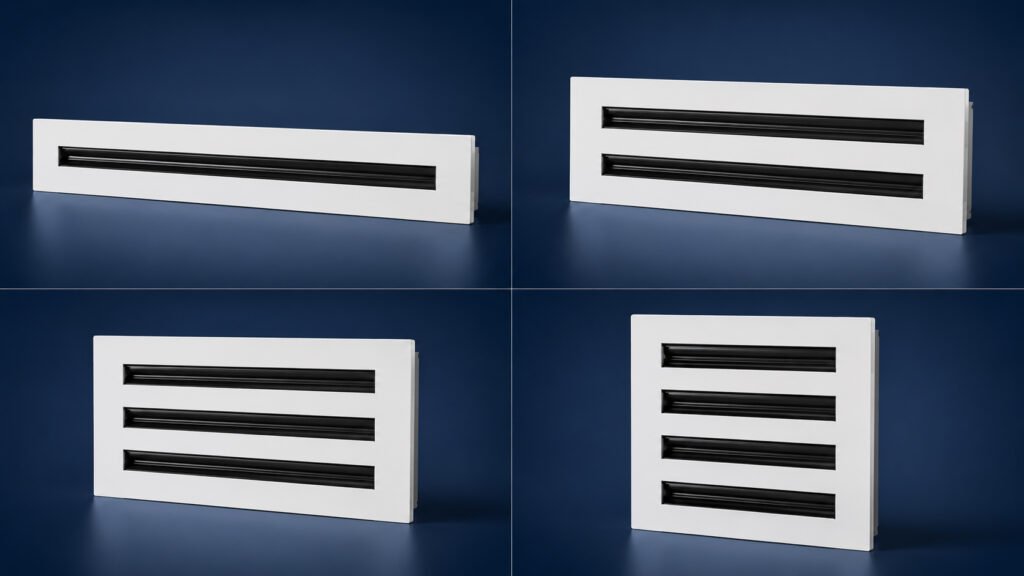
A linear slot diffuser is a long, narrow air outlet installed in ceilings, walls, bulkheads, or window perimeter areas. It normally contains one or more continuous slots with adjustable internal blades.
These blades allow the airflow direction to be adjusted according to the room layout and HVAC design.
Linear slot diffusers are commonly used in:
- Hotels and luxury residences
- Modern offices
- Shopping malls
- Airports
- Restaurants
- Perimeter air-conditioning systems
- Architectural ceiling designs
Their slim profile makes them popular in projects where appearance is as important as airflow performance.
Explore JOYOAIRE’s linear slot diffuser options for architectural and commercial HVAC projects.
What Is a Square Ceiling Diffuser?
A square ceiling diffuser is a conventional HVAC air outlet designed to distribute supply air in multiple directions. The most common type is the four-way ceiling diffuser, which spreads air evenly across the ceiling.
Square diffusers are frequently installed in suspended ceiling grids and connected to the duct system using a plenum box or flexible duct.
Typical applications include:
- Offices
- Schools
- Hospitals
- Retail stores
- Meeting rooms
- Commercial buildings
- Industrial facilities
They offer simple installation, reliable airflow distribution, and relatively low project costs.
View JOYOAIRE’s square ceiling diffuser solutions for suspended ceilings and general commercial applications.
Linear Slot Diffuser vs Square Ceiling Diffuser: Key Differences
| Feature | Linear Slot Diffuser | Square Ceiling Diffuser |
|---|---|---|
| Appearance | Slim and architectural | Conventional and functional |
| Airflow pattern | Directional and adjustable | Multi-directional distribution |
| Installation | Requires accurate coordination | Easy to install in ceiling grids |
| Best application | Premium and modern interiors | General commercial spaces |
| Layout flexibility | Suitable for continuous installations | Suitable for individual ceiling locations |
| Cost | Usually higher | Usually more economical |
| Maintenance | Access depends on the installation design | Generally easy to remove and clean |
| Customization | Length, slots, finish, and configuration | Size, neck, and airflow direction |
1. Airflow Distribution
Airflow performance is one of the most important differences between these two diffuser types.
A linear slot diffuser creates a controlled air pattern along the ceiling. Depending on the internal blade position, the air can be directed horizontally, vertically, or toward a specific area.
This makes it useful for perimeter zones, large windows, narrow rooms, and spaces requiring precise airflow control.
A square ceiling diffuser normally distributes air in two, three, or four directions. A four-way diffuser provides broad coverage and is effective in open rooms with regular ceiling layouts.
The correct choice should be based on:
- Required airflow volume
- Ceiling height
- Air velocity
- Throw distance
- Room dimensions
- Heating or cooling mode
- Acceptable noise level
Neither design is automatically better. The correct diffuser must match the HVAC system’s calculated airflow requirements.
Air distribution design should also follow applicable guidance from ASHRAE.
2. Appearance and Interior Design
Linear slot diffusers provide a minimalist and modern appearance. They can be installed as individual sections or arranged in continuous lines to blend with lighting systems and architectural ceiling details.
This makes them a preferred option for hotels, showrooms, premium offices, villas, and other design-focused projects.
Square ceiling diffusers are more visible but integrate easily into standard suspended ceiling grids. Their appearance is practical and familiar, making them suitable for projects where function and budget are the main priorities.
Choose a linear slot diffuser when architectural integration is important. Choose a square ceiling diffuser when a simple and efficient ceiling outlet is sufficient.
3. Installation Requirements
Square ceiling diffusers are generally easier and faster to install. Standard models are designed to fit common ceiling modules and can be connected to round or square duct systems through a plenum box.
Linear slot diffusers require more detailed coordination between the HVAC contractor, ceiling contractor, and interior designer.
The installer must consider:
- Exact diffuser length
- Number of slots
- Ceiling opening dimensions
- Plenum box size
- Duct connection position
- End caps and joining sections
- Alignment with ceiling features
For continuous linear installations, accurate manufacturing and installation are especially important.
4. Cost Considerations
Square ceiling diffusers are usually the more economical choice. Their standard sizes, simple construction, and convenient installation help reduce both product and labor costs.
Linear slot diffusers may cost more because of their customized lengths, adjustable components, plenum boxes, surface finishes, and installation requirements.
However, the lowest initial price should not be the only consideration. Poor diffuser selection can cause drafts, uneven temperatures, excessive noise, or an unsatisfactory interior appearance.
5. Customization Options
Linear slot diffusers generally provide more architectural customization. Buyers can specify the diffuser length, number of slots, slot width, finish, color, end-cap configuration, and plenum box connection.
They can also be manufactured as separate sections and joined during installation to create a continuous appearance.
Square ceiling diffusers are normally supplied in standard dimensions that match common suspended ceiling systems. However, customized neck sizes, airflow directions, finishes, and mounting options may also be available.
For OEM and project orders, the required dimensions and installation details should be confirmed before production.
When Should You Choose a Linear Slot Diffuser?
A linear slot diffuser may be the better choice when:
- The project requires a modern architectural appearance
- Air must be directed toward windows or perimeter zones
- The ceiling design includes long or narrow air outlets
- Adjustable airflow direction is required
- The diffuser must integrate with lighting or ceiling features
- Customized lengths or finishes are needed
Linear slot diffusers are particularly suitable for premium commercial and residential projects where both appearance and airflow control are important.
When Should You Choose a Square Ceiling Diffuser?
A square ceiling diffuser may be more appropriate when:
- The room has a standard suspended ceiling
- Broad multi-directional airflow is required
- Installation time must be minimized
- The project has a limited budget
- Easy maintenance is important
- The room has a regular or open layout
Square ceiling diffusers are a practical solution for offices, classrooms, stores, hospitals, and general commercial buildings.
Can You Replace One Type with the Other?
A linear slot diffuser should not be replaced directly with a square ceiling diffuser—or vice versa—without checking the HVAC design.
The replacement may change:
- Air velocity
- Throw distance
- Pressure drop
- Noise level
- Airflow direction
- Required duct connection
- Ceiling opening dimensions
Before replacing a diffuser, confirm the airflow data and installation requirements with the HVAC engineer or diffuser manufacturer.
How to Select the Correct Diffuser
Before placing an order, prepare the following project information:
- Required airflow volume for each outlet
- Supply or return air application
- Ceiling height and room dimensions
- Duct connection size and position
- Required diffuser dimensions
- Ceiling installation type
- Surface finish and color
- Acceptable noise level
- Required plenum box configuration
- Project quantity and delivery schedule
Providing complete technical information helps the manufacturer recommend the correct diffuser size and configuration.
Final Recommendation
The choice between a linear slot diffuser and a square ceiling diffuser depends on the project’s airflow requirements, ceiling design, budget, and architectural expectations.
Choose a linear slot diffuser for precise airflow control, customized layouts, and modern interiors.
Choose a square ceiling diffuser for broad air distribution, straightforward installation, and cost-effective commercial applications.
For the best result, always select the diffuser according to technical performance data rather than appearance alone.
Frequently Asked Questions
Which diffuser is quieter?
Neither type is inherently quieter. Noise depends on airflow volume, diffuser size, neck velocity, pressure, plenum design, and installation conditions.
Correctly sizing the diffuser and maintaining an appropriate air velocity are essential for controlling noise.
Are linear slot diffusers better for modern buildings?
They are often preferred in modern buildings because of their slim appearance and architectural flexibility. However, square ceiling diffusers may still provide a more economical solution for standard rooms and suspended ceilings.
Can linear slot diffusers be used for both supply and return air?
Yes. Linear slot products can be configured for supply or return air, but the internal structure and plenum design may differ.
The required application should be confirmed before ordering.
Which diffuser is easier to maintain?
Square ceiling diffusers are generally easier to remove and clean. Linear slot diffusers can also be maintained efficiently when access is considered during the ceiling and HVAC design stage.
Can these diffusers be customized?
Yes. Dimensions, finishes, colors, slot quantities, neck sizes, airflow patterns, and plenum boxes can be customized according to the project requirements and manufacturing capabilities.
Looking for Custom HVAC Air Diffusers?
JOYOAIRE supplies linear slot diffusers, square ceiling diffusers, plenum boxes, grilles, and other HVAC air distribution products for commercial and residential projects.
We support customized dimensions, surface finishes, airflow configurations, and OEM/ODM manufacturing.
Need help selecting the correct diffuser size, airflow configuration, or surface finish?
Contact JOYOAIRE or request a project quotation to discuss your HVAC project requirements.